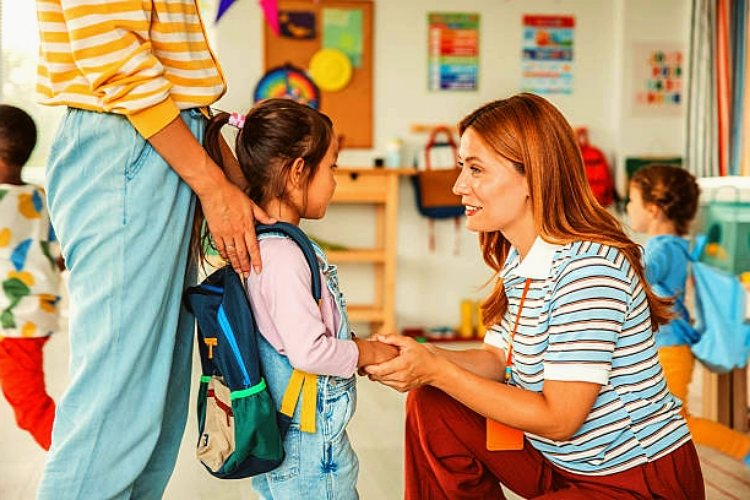
 Many believe empathy is a trait which children are born with. A good child. A bad child. This belief does a disservice to empathy because it implies that empathy is predetermined and cannot be developed through learning and reinforcement.
Research proves otherwise. Children between the ages of two and five are at one of the most crucial stages of brain development. Neural connections are being formed rapidly and habits that develop socially and emotionally at this time are likely to endure. Therefore, teaching a child how to identify and react to the emotions of others is not a false hope but rather taking advantage of the natural development of the brain.
Emotional Literacy Comes First
For a child to become a caring, tuned-in adult, they first need two things: a safe enough childhood that they trust the world, and the emotional fluency to say what’s in their heart. Then, and only then, can they begin to turn that toolbox on other people.
That foundation starts earlier than most parents realise. Long before a child can name what they’re feeling, they’re watching how the adults around them handle big emotions, whether frustration gets swallowed, shouted out, or talked through. Those early observations quietly shape the emotional vocabulary a child builds over years. A home where feelings are named, validated, and moved through becomes a kind of emotional classroom, whether anyone intends it that way or not.
This is why pushing empathy too soon can backfire. A child who hasn’t yet learned to recognise and sit with their own discomfort will struggle to hold space for someone else’s. It’s not selfishness, it’s simply that the skill hasn’t been built yet. Emotional literacy has to go inward before it can reach outward, and that takes time, patience, and plenty of low-stakes practice.
The good news is that the day-to-day moments parents often overlook are exactly where this learning happens. Talking through a falling-out with a friend, naming the disappointment after a cancelled plan, or asking “how do you think she felt when that happened?” after a story, these small, repeated conversations do far more than any single lesson ever could. Over time, they add up to a child who doesn’t just feel things deeply, but understands them.
What Group Environments Actually Teach
The family is where you learn emotional intelligence, but its lessons can only take root in the wider world. At home, kids are in a friendly dictatorship. Those who surround the child (often grown-ups and older children) adapt to their developing needs and desires, with no negotiation.
But walk into a childcare setting filled with toddlers sometime and you will witness a democratic nightmare. Everyone suddenly wants something different. Accommodating their friends isn’t a concept yet. Throughout the day, you must share your favorite book. And the red truck. And the yellow crayon.
It’s here that we see why kind, empathetic, measured adults (who are so muscularly versatile that they can lift a 30lb child and breathe calmly while doing hundreds of dishes) deserve the real money. This is the kind of Preschool Auckland parents should actively look for: programs where emotional literacy and empathy aren’t treated as extras, but as part of the daily curriculum.
A 20-year study, published in the ‘American Journal of Public Health’, followed children from kindergarten through to the age of 25. Those early social skills turned out to be predictors of adult outcomes: the kindergartners who showed the most positive sharing, helping, and other small-human interactions were most likely to have obtained a college degree and held a full-time job by the time they turned 25.
What Parents Can do at Home
Looking at picture books is an underappreciated method for parents to help foster empathy in their kids. Not just looking, questioning. Stop at a page where a character is sad and ask your child what that character is sad about. Ask your child what might they might be able to do? Ask what they think would help.
This approach helps kids develop perspective-taking, the developmental step when kids start to understand that other people have minds of their own. It seems simple, but a three-year-old truly doesn’t understand that when they close their eyes, they can’t see you. They have to be taught this concept, and stories provide a safe, low-stakes way for children to practice without any real-world consequences.
Beyond books, the same questioning habit transfers naturally into everyday life. A cartoon character who loses a race, a neighbour who seems upset, a sibling in tears over something that seems minor, all of these become small, real-time opportunities to pause and wonder aloud together. “What do you think is going on for them?” is one of the most powerful questions a parent can ask, not because the child will always get it right, but because the habit of asking builds the mental muscle over time.
Role play is another tool that tends to be underused once children get past the toddler years. Swapping perspectives, letting a child play the friend who was left out, or the teacher who had a hard day, gives them a felt sense of another person’s experience that talking alone can’t always reach. It doesn’t need to be elaborate or structured; even a few minutes of “let’s pretend” with a specific emotional scenario woven in can plant something that sticks.
It also helps to narrate your own emotional life in small, age-appropriate ways. When a parent says “I felt a bit left out today, and I noticed I went a bit quiet, did you ever feel like that?” they’re modelling both the awareness and the language that empathy runs on. Children don’t learn to be emotionally literate by being told to, they learn by watching someone they love do it, imperfectly and honestly, again and again.
Moving Away From Punitive Discipline
The overall change that is occurring in these innovative childhood environments, i.e., moving from using a time-out to having a restorative conversation is not easier or gentler. In fact, it’s more challenging.
When a child has a time-out, they have to sit quietly and just feel badly. When a child has a restorative conversation, they are asked to think about how the other child is feeling, listen to how their actions impacted that child, and then consider how to make things right. This requires cogent empathy, emotion management, and actual labor. It’s a more difficult process for the child. It’s also a more difficult process for the educator or parent leading the restorative conversation. But it works best.
Co-regulation, where a regulated adult stays with an upset child and teaches them to also become regulated rather than a dysregulated adult removing the problem, is the key to the process. Just like “sharing”, “taking turns”, and “calm down,” children can best learn “emotional regulation” by being supported and coached by adults to master the skills when they are quite young. And the younger the more learning-prone and the most practice time.