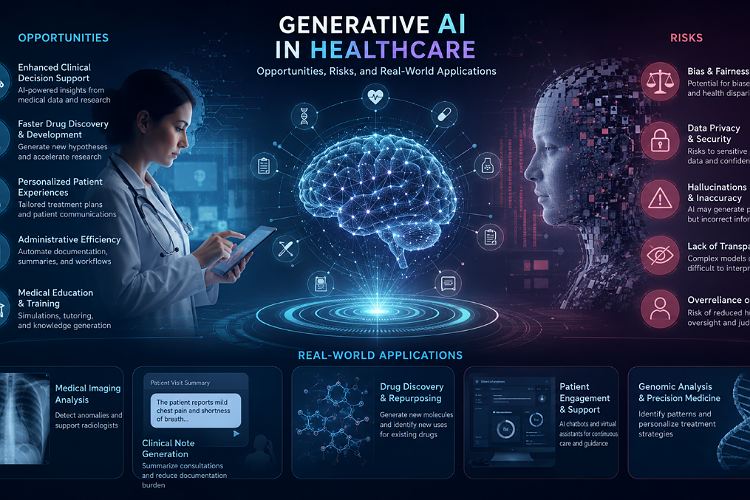
 The healthcare industry has traditionally approached digital innovation with a healthy dose of conservatism. This caution is well-founded: unlike in fintech or retail, a mistake here costs more than financial loss—it costs human lives. However, the advent of generative artificial intelligence (GenAI) created a precedent that even conservative paradigms could not ignore. Today, generative AI has evolved from a flashy science-fiction concept into a core foundational element of modern medical systems.
From streamlining Electronic Health Record (EHR) workflows to modeling novel molecular structures for drug discovery, the technological shift is undeniable. Yet, delivering high-impact medical AI solutions demands deep technical expertise and a thorough grasp of regulatory compliance. In this landscape, a comprehensive approach to Healthtech Development becomes the deciding factor: simply training a language model isn’t enough; it must be securely integrated into a tightly regulated clinical ecosystem.
Below, we take an in-depth look at the opportunities unlocked by generative AI, the critical risk factors facing the industry, and how GenAI solutions are actively deployed in real-world practice today.
1. New Horizons: Key Opportunities for GenAI in Medicine
Generative AI fundamentally differs from traditional (analytical) machine learning. While classic algorithms excel at classification tasks (“Is there a tumor in this scan?”), generative models can synthesize entirely new content—including text, synthetic patient data, molecular structures, and complex visual outputs.
A. Combating Physician Burnout and Streamlining Documentation
One of the most pressing challenges in modern clinical practice is the overwhelming administrative burden. Physicians spend up to 40% of their working hours filling out charts, drafting discharge summaries, and entering data.
Generative AI scribes integrated directly into clinical workstations can listen to patient-doctor dialogues in real time, extract key medical insights, and automatically generate structured clinical notes. This reduces documentation time by 40–50%, allowing doctors to focus on the patient rather than their computer screens.
B. Synthetic Data and Model Training
Training medical AI systems has historically suffered from one major bottleneck: access to real-world data. Stringent privacy regulations (such as HIPAA in the US or GDPR in Europe) heavily restrict the sharing of medical records.
GenAI solves this dilemma by generating synthetic medical data. These models create digital twins of medical histories that mirror the statistical relationships and disease progressions of real patients without containing any personally identifiable information (PII). This drastically accelerates clinical trial simulations and AI model training.
C. Personalized Medicine and Drug Discovery
In the pharmaceutical industry, bringing a new drug to market traditionally took 10 to 15 years and required billions of dollars in R&D. Generative AI is fundamentally revolutionizing this process through in silico drug design. Algorithms can generate entirely novel molecular structures with targeted chemical and biological properties, predict protein folding, and simulate drug interactions before a single physical experiment is conducted.
2. The Flip Side: Risks and Implementation Challenges
Despite its immense potential, implementing generative AI in healthcare carries significant risks. Ignoring these factors can lead to legal liabilities, compliance breaches, and, most critically, medical errors.
Hallucinations and Clinical Accuracy
Large Language Models (LLMs) operate on probabilistic principles: they predict the most likely next word given a specific context. This inherent architecture makes them prone to “hallucinations”—generating plausible-sounding but entirely fabricated facts.
Clinical Risk: If an AI model hallucinated an incorrect drug dosage or invented a non-existent allergy in a patient’s history, the clinical consequences could be catastrophic.
Data Privacy and Security
Using public cloud models to process sensitive medical data creates severe vulnerability to data leaks. Maintaining patient confidentiality requires end-to-end encryption, local (on-premise) deployments, or secure, isolated cloud environments with real-time data anonymization.
Ethical Considerations and Bias
If a model is trained on historical datasets that reflect disparities in care (such as an underrepresentation of rare diseases or specific demographic groups), the GenAI system will perpetuate and amplify those exact biases.
The Black Box Problem
Clinicians must understand why a system suggests a specific diagnosis or treatment plan. Generative models with billions of parameters often fail to provide a transparent, step-by-step reasoning chain, making their integration into formal Clinical Decision Support Systems (CDSS) a complex challenge.
3. Real-World Applications: Where GenAI Works Today
To grasp the actual scale of transformation, we need only look at how leading medical centers and global pharmaceutical companies are deploying generative AI today.
1. Radiology and Pathology Workflow Automation
Solutions like Nuance (a Microsoft company) with its DAX Copilot demonstrate GenAI in action. These tools assist radiologists by analyzing CT, MRI, and X-ray reports, automatically drafting structured clinical summaries. Radiologists simply review, edit, and sign off on the draft, cutting case handling times by up to 30%.
2. Clinical Decision Support (CDSS)
GenAI-powered clinical support tools are trained on vast repositories of up-to-date medical journals, clinical guidelines, and research papers. When a clinician faces a complex or rare case, the AI analyzes the patient’s record in seconds and presents potential differential diagnoses alongside links to peer-reviewed evidence, acting as an advanced clinical co-pilot.
3. Personalized Patient Engagement
Next-generation conversational AI moves far beyond rigid rule-based chatbots. These assistants maintain empathetic, natural dialogues with patients post-surgery or during chronic disease management. They translate complex medical jargon into easy-to-understand terms, remind patients to take medication, track symptoms, and escalate alerts to treating physicians when necessary.
Comparative Analysis: Traditional IT Systems vs. GenAI in Healthcare
| Feature | Traditional Medical IT Systems | Generative AI Platforms |
| Data Processing | Highly structured (databases, forms) | Unstructured (text, audio, imaging, genomic data) |
| User Interaction | Forms, drop-downs, rigid menus | Natural language prompts |
| Adaptability | Requires manual code reconfiguration | Learns and adapts from new contextual data |
| Core Value | Data storage and record transmission | Synthesis, deep analysis, and content generation |
Conclusion: Human + AI, Not AI Instead of Human
Generative AI in healthcare is not a replacement for doctors; it is a catalyst designed to give them “superpowers.” By handling repetitive, administrative, and computationally heavy tasks, GenAI frees clinicians to focus on what matters most: direct patient care and critical decision-making.
The success of GenAI in medicine rests on balancing three pillars: technological maturity, strict data security compliance, and continuous clinical oversight (Human-in-the-Loop). Healthcare organizations that invest in building robust architectures and adapting their clinical workflows today will lead the next era of high-tech, patient-centered care.