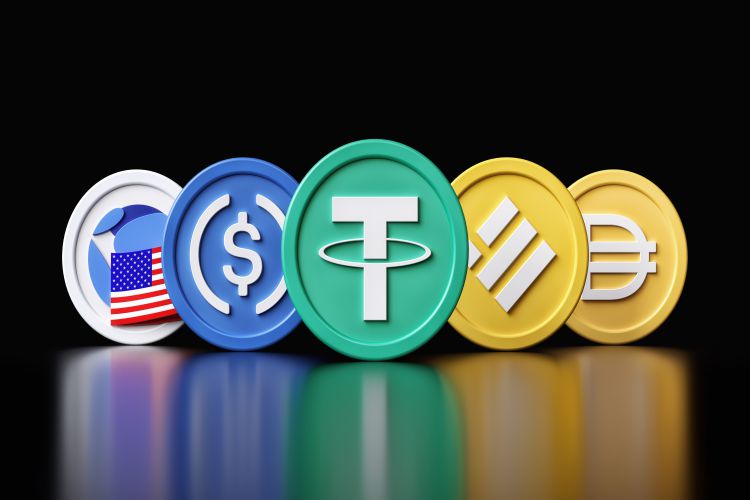
 In 2025, stablecoin payments have quietly become the backbone of global financial infrastructure. Yet, most people remain unaware they’re using them. Throughout this year, stablecoins processed $9 trillion in transactions, a 87% year-over-year increase. To put this into perspective, these transactions now rival half of Visa’s annual payment volume and exceed PayPal by five times. What makes this shift remarkable is that this silent revolution operates beneath traditional finance as institutions, merchants, and consumers adopt infrastructure that makes money programmable, global, and instant. Crucially, the story isn’t about cryptocurrency speculation; it’s about stablecoin payments solving real operational problems legacy systems cannot address efficiently.
The Market Reality: $9 Trillion in Transactions
The stablecoin market capitalization surpassed $300 billion for the first time in October 2025, marking 25 consecutive months of sustained growth. Tether’s USDT dominates with a 58% market share and $176.3 billion in capitalization. Circle’s USDC commands second place with 24.5% at a $74 billion cap. That’s a combined 82.5% of the total stablecoin market. Comparing USDT vs USDC reveals a clear market segmentation. Tether leads in trading volume and global reach, while USDC serves institutions that prioritize compliance and transparency.
Monthly transaction volumes now routinely exceed $1 trillion, with September 2025 recording an adjusted volume of $1.25 trillion. Unlike previous years, these transactions represent real value movement through legitimate payment channels, not speculation. More than 25,000 merchants worldwide now accept stablecoins for direct transactions. A 2025 Deloitte survey found that 85% of U.S. merchants view enabling crypto payments as a high priority. It appears that infrastructure standardization is inevitable.
And clearly, the cost advantage is compelling. Cross-border transaction fees have dropped by up to 70%. Remittance fees plummeted from traditional 5-12% to under 2% in stablecoin corridors. Settlement times have collapsed from days to minutes. 24/7 availability eliminates delays from weekends, holidays, and time zones. Businesses that process over $1 million in monthly cross-border transactions are 92% more likely to adopt stablecoin instead of alternative payment methods.
Why Institutions Are Adopting Now
The institutional inflection point arrived in July 2025 with the passage of the US GENIUS Act. It was the first real step to establish clear conditions for stablecoin reserves, stability, and oversight. The legislation requires issuers to back reserves 1:1 with U.S. dollars or low-risk Treasury securities. It also mandates monthly attestations, annual independent audits, and full compliance with the Bank Secrecy Act. That piece of regulation removed the primary barriers that prevented major institutions from embracing blockchain-based payment infrastructure.
Now that at least some of the uncertainty is removed, major payment networks have moved quickly. Mastercard recently announced a strategic partnership with Thunes to enable near real-time payouts to stablecoin wallets, allowing gig economy workers to receive instant payments without multi-day delays. It focuses on markets where traditional banking is still costly or unavailable. Workers can receive instant payouts and convert earnings to local currency.
Visa took a different approach and integrated stablecoins directly into its existing merchant settlement infrastructure. The company is now piloting stablecoins for 24/7 merchant payouts, bypassing traditional banking hour limitations.
Even legacy remittance providers are adapting. Western Union, facing competition from faster and cheaper stablecoin corridors, has finally begun testing stablecoin settlements in select markets. The move signals that traditional remittance giants recognize stablecoins as viable infrastructure, not just speculative technology.
Where Stablecoins Win: Speed, Cost, and Access
Core Advantages
Stablecoin’s competitive advantage rests on three pillars. First, stablecoin settlement speed eliminates delays inherent in legacy rails. Whereas traditional wire transfers require hours or days across correspondent banking networks, blockchain settlement occurs in minutes with irreversible finality. Second, cost reductions reach 60-80% in cross-border flows by eliminating intermediaries. Third, 24/7 availability suits global operations across all time zones without institutional constraints.
E-Commerce
In e-commerce specifically, stablecoins transform unit economics for merchants. Apart from earning more per customer (some payment processors claim up to 30% higher average basket), merchants also eliminate chargeback risk through immediate, irreversible settlement. Platforms like Stripe report that customers using stablecoins are 2x more likely to be new customers. It is safe to assume that stablecoins unlock previously unreachable markets.
Remittances
For remittances, the impact proves truly transformational. Sending $200 from Nigeria to Benin traditionally costs over $42. With stablecoin transfers through cross-border blockchain corridors, this cost drops below $0.01. Stablecoin remittances average 2.5% fees versus 5-6% through traditional banking channels. Stablecoins already account for 5-10% of remittance flows in the U.S.-Mexico corridor, with adoption accelerating further as fees fall below 1%.
Corporate Treasury
Beyond consumer payments, stablecoins are reshaping how companies manage cash across borders. Enterprise treasury teams report transaction fees dropping by up to 80% compared to traditional wire transfers, with settlement times accelerating from days to minutes. The advantage isn’t just speed; it’s operational control. Treasury teams can automate routine tasks through smart contracts. Funds move automatically when needed. They transfer excess cash between accounts. Vendors get paid as soon as delivery conditions are met. They manage foreign exchange exposure through programmed trading parameters. No human intervention needed.
But the strategic applications extend even further. More than $146 billion in stablecoins now serve as collateral and operational capital within decentralized finance protocols, funding yield-bearing treasury operations that traditional banking cannot match. Companies are using stablecoins not just to move money faster. In fact, they put idle corporate cash to work 24/7/365, earning returns while maintaining liquidity.
Emerging Markets Leading the Charge
Unique wallet addresses worldwide rose from 350 million in 2023 to 500 million in 2025, a 30% annual increase. Latin America, Africa, and Southeast Asia drive the fastest stablecoin adoption globally. In Brazil, over 90% of cryptocurrency flows are now stablecoin-related, according to Gabriel Galipolo, the country’s central bank chief. Stablecoins provide hedges against local currency volatility and efficient cross-border transfer mechanisms. Financial institutions across Latin America show strong momentum. 86% say they have partnerships in place, and 71% report their infrastructure is ready for stablecoin integration.
Africa presents the most compelling emerging market use case. High foreign exchange costs, limited access to USD liquidity, and remittance fees exceeding 6.6% have driven urgent adoption. Fireblocks’ 2025 survey revealed that half of global financial institutions are piloting or actively using stablecoins. Here too, emerging markets are leading because they must solve real operational problems that legacy systems cannot address efficiently. The Philippines, Nigeria, and Kenya emerged as top remittance corridors where stablecoin adoption accelerated most rapidly.
The Infrastructure Race
Ethereum dominates with approximately 70% of all stablecoin supply, but competitors are fighting hard for high-speed payment flows. Solana’s circulating supply of stablecoins reached $17.5 billion by October 2025, attracting users with sub-$0.01 transaction costs and sub-second settlement times. Tron continues to lead in monthly stablecoin transaction count. It processes 6.8 times more daily USDT transactions than Ethereum through consistently low fees.
The competition is forcing stablecoin issuers to expand aggressively. PayPal recently deployed PYUSD to seven additional blockchains, including Tron, Avalanche, Aptos, and Sei, via LayerZero integration. “We will enable PYUSD to reach new markets faster while maintaining compliance and composability from day one,” said David Weber, head of ecosystem for PayPal USD.
The Big Three Stablecoin Players
Tether (USDT) maintains market dominance with consistently high volumes, processing approximately $703 billion monthly and peaking at $1.01 trillion in June 2025. The company projects $15 billion in net profit for 2025, driven by interest income from Treasury security reserves. USDT dominates trading and emerging market remittances.
While Tether leads in volume, Circle (USDC) has carved out a distinct competitive position through regulatory compliance. With monthly attestations and U.S. oversight, USDC positions itself as institutional-grade digital payments infrastructure. USDC supply reached $74 billion in October 2025. Comparing USDT vs USDC, Circle wins in institutional credibility even as Tether leads in absolute volume.
PayPal USD (PYUSD) takes a different approach entirely, leveraging PayPal’s 430+ million consumer and merchant accounts to drive mainstream adoption. Unlike competitors, PYUSD integrates directly into PayPal’s existing payment infrastructure, allowing users to send, spend, or convert the stablecoin without understanding blockchain technology. PayPal launched a 3.7% annual yield program in 2025 to encourage broader adoption.
Looking Ahead: The Next 24 Months
Projections suggest stablecoin market capitalization will reach $1.2 to $2 trillion by 2028. Institutions that embed stablecoins as backend infrastructure now will gain a decisive competitive advantage early on. Improving cross-border payments and eliminating intermediaries through stablecoin adoption could drive savings of up to $26 billion by 2028.
Yet real risks persist. Nearly half of consumers still worry about security and privacy. Reserve rules have weaknesses. For example, Stablecoins can hold uninsured bank deposits that might freeze up during a crisis. Cross-border regulations don’t align, complicating reserve access when it matters most. Technical vulnerabilities persist, too: exploited smart contracts and hacked bridges have caused significant losses. These aren’t theoretical concerns; they’re active challenges the industry must address as transaction volumes scale.
The hidden engine of digital payments gains visibility not through user interface changes but through backend infrastructure evolution. The winners in this transition are payment providers and institutions that preserve familiar customer interfaces while dramatically improving operational efficiency beneath the surface. Stablecoin payments won’t replace the dollar but will digitize currency itself, programmable, global, and instant by design.
The quiet revolution is complete. Stablecoins have achieved what remains rare in financial technology: genuine market fit solving real operational problems at scale. The transformation happening in 2025 is not theoretical. It is already embedded in the digital payments infrastructure that billions use daily.