Why most booths get ignored
Conventions can be tiring for those who join. With the first 60 minutes, nearly all vendors mix together – similar pop-up banners, similar branded pens, and a similar uninspired sales pitch from a person possibly uninterested. If your booth resembles their booth, they’ll pass your booth. The simplest approach to stand out is to be different. For every predictable, there’s an opportunity.
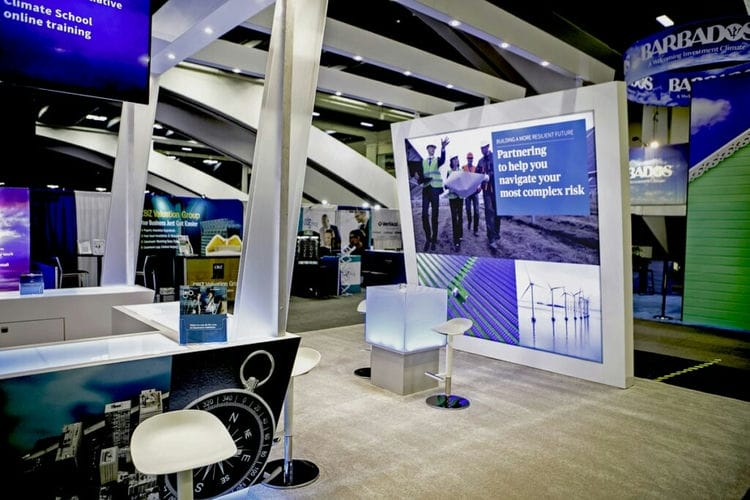
Stop displaying and start attracting
The biggest mistake many exhibitors make is that they consider their booth as a simple exhibit rather than an interactive space. Yes, a poster provides information about your company. But an experience actually touches people’s emotions, and that is what creates a lasting memory and dialogue.
High-motion visual attractions are often referred to as creating a “herd effect” – when someone pauses to watch, others will do the same. The crucial moment is when someone passes by and decides if they want to enter or just continue walking. A visually compelling attraction close to the edge of your booth will change this decision. Instead of considering whether they should stop, people will just walk in.
Static elements won’t make people stop. But something dynamic will.
Give attendees something worth sharing
Today’s trade show attendee is a mobile company unto themselves. They’re posting to LinkedIn and Instagram between hobnobbing with vendors. This isn’t a distraction, it’s a wide open door.
Put sensational content in the hands of a trade show attendee, and they will share it with their entire network. 81% of trade show attendees have buying authority. These people are all here on business.
The quickest way to make the magic happen is by using top-of-the-line visual tech like glambot photo booth hire. A glambot uses pricey cinema robotics technology to capture Hollywood red carpet style footage of attendees. Attendees post that content and everybody sees your booth’s branding in their feed. Voila. Free branding.
Build the lead capture into the attraction itself
Many companies fail to capitalize on the money-making lead potential of their photo or video attraction at a trade show. Lead retrieval should be a part of the workflow to ensure that contact details go directly to your CRM system. This gives you qualified leads, paired with their content profile and a clear indication of what they found interesting enough to take away with them.
Don’t treat lead capture as a separate step that happens after someone’s already walking away. Embed it into the moment – a quick form on the screen before the content is delivered, or a branded microsite where attendees go to collect their video. If the exchange feels natural and the payoff is immediate, people won’t think twice about handing over their details. You get the data while they’re still engaged, not after the novelty has worn off.
Train your staff to work the line
Your staff aren’t just there to explain products. At a high-traffic activation, their job is to work the crowd before the formal conversation even begins.
People waiting in line for an experience are warm and receptive. They chose to stop. They chose to queue. That’s an unusual level of self-selection at a trade show, and it’s a window your staff should be walking through. A well-trained brand ambassador uses that wait time to qualify the prospect, learn about their business, and set up the conversation that happens after the experience ends.
The “attraction-to-interaction” bridge is a repeatable process, not a happy accident. Brief your team specifically on it. Who asks the opening question, when, and what they’re listening for in the answer.
Make the layout do half the work
Booth design affects traffic more than most exhibitors realize. Your most visually striking element should be placed where it’s visible from the main aisle, not buried inside the booth where someone has to already be interested before they see it.
Put the draw near the perimeter. Let it work as a beacon. Use lighting and motion to separate your space from the flat, neutral booths around you. Proximity matters too – if your activation is visible at a distance, people will navigate toward it intentionally rather than stumbling across it by chance.
The layout, the attraction, the staff workflow, and the lead capture have to work as a connected system. When they do, booth traffic stops being a luck-based outcome and starts being something you can reliably engineer from one show to the next.